Tuesday, 25 July 2017

Bouzigues to Mèze – 8 km


We have been going on about the oysters, so here they are. Succulent, fresh and sweet. Just 12 euro for the dozen, and seven for half a litre of very acceptable white wine. This is the life!


The wind dropped during the night, and we awoke quite early and optimistic. But it started filling in as we had our coffee, and it was with some trepidation that we decided to go for the quick trip – just an hour – round to Mèze. Although it is just along the shore of the lagoon, you have to go right out into the middle to skirt the oyster farms, and it did get quite bumpy, with spray coming over the bows regularly. Saskia is not used to that!


As we approached Mèze, we saw the oystermen hard at work, wind or no wind.


The village is attractive. Rather larger than Bouzigues, and with more facilities.
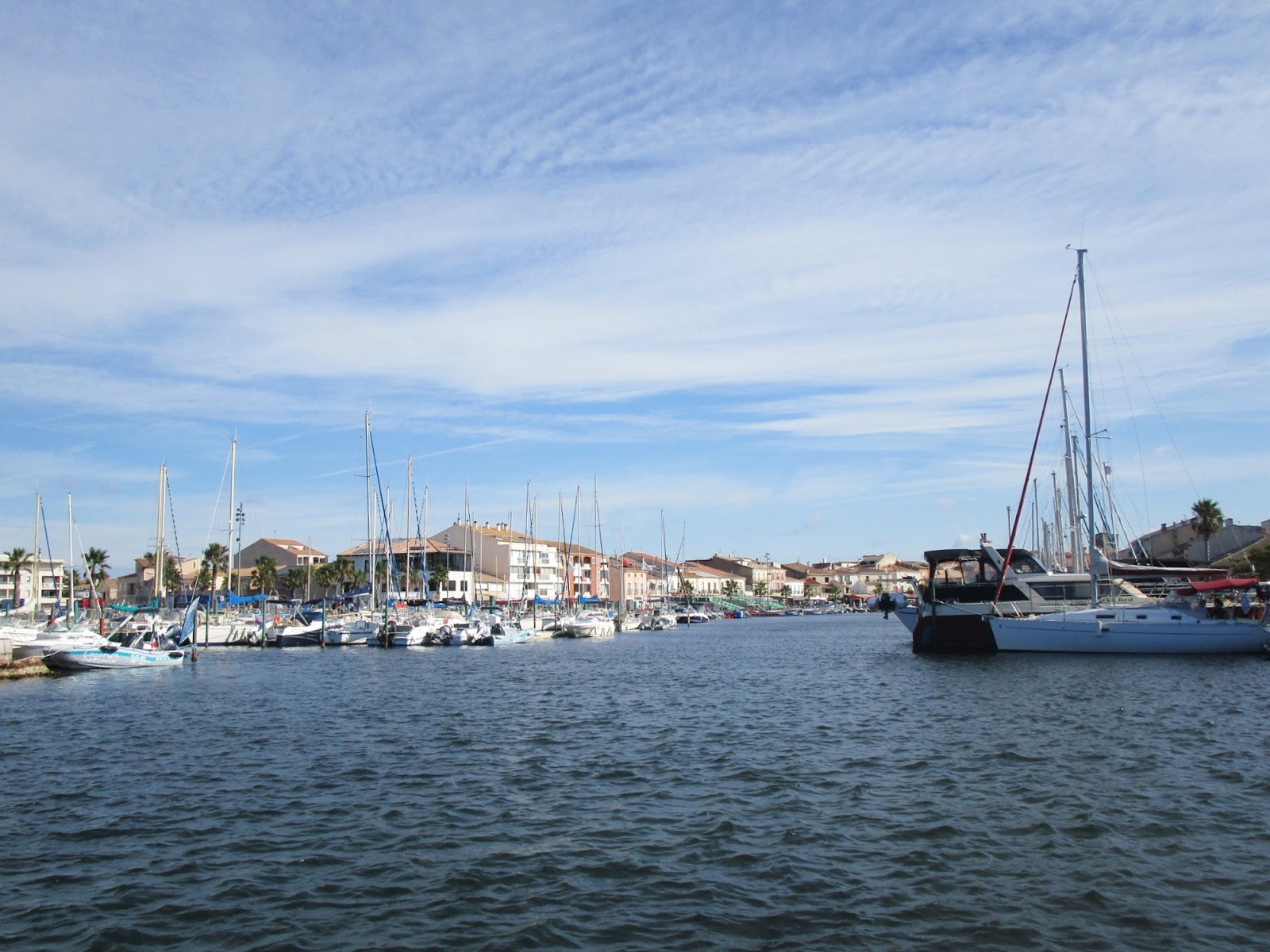

With the wind howling, we were relieved to find space on the visitors’ quay, and the efficient lady harbour-master (harbour-mistress? harbour-person?) ready to help us dock.

After paying quite a lot for the night (42 euro), we established where Olivier Filippi's nursery is, and decided to set off. It might be hot now, it would certainly be hotter later. In fact, it was lucky we did go straight away, since it turned out the place only opens in the mornings in July and August. To walk all the way out there and find it closed would have been truly discouraging.


We walked up narrow, winding streets until we hit the main road out of town. Then it was a fairly long straight slog, but OK.


Here in the nursery, you can see an eager gardener inspecting the offerings.
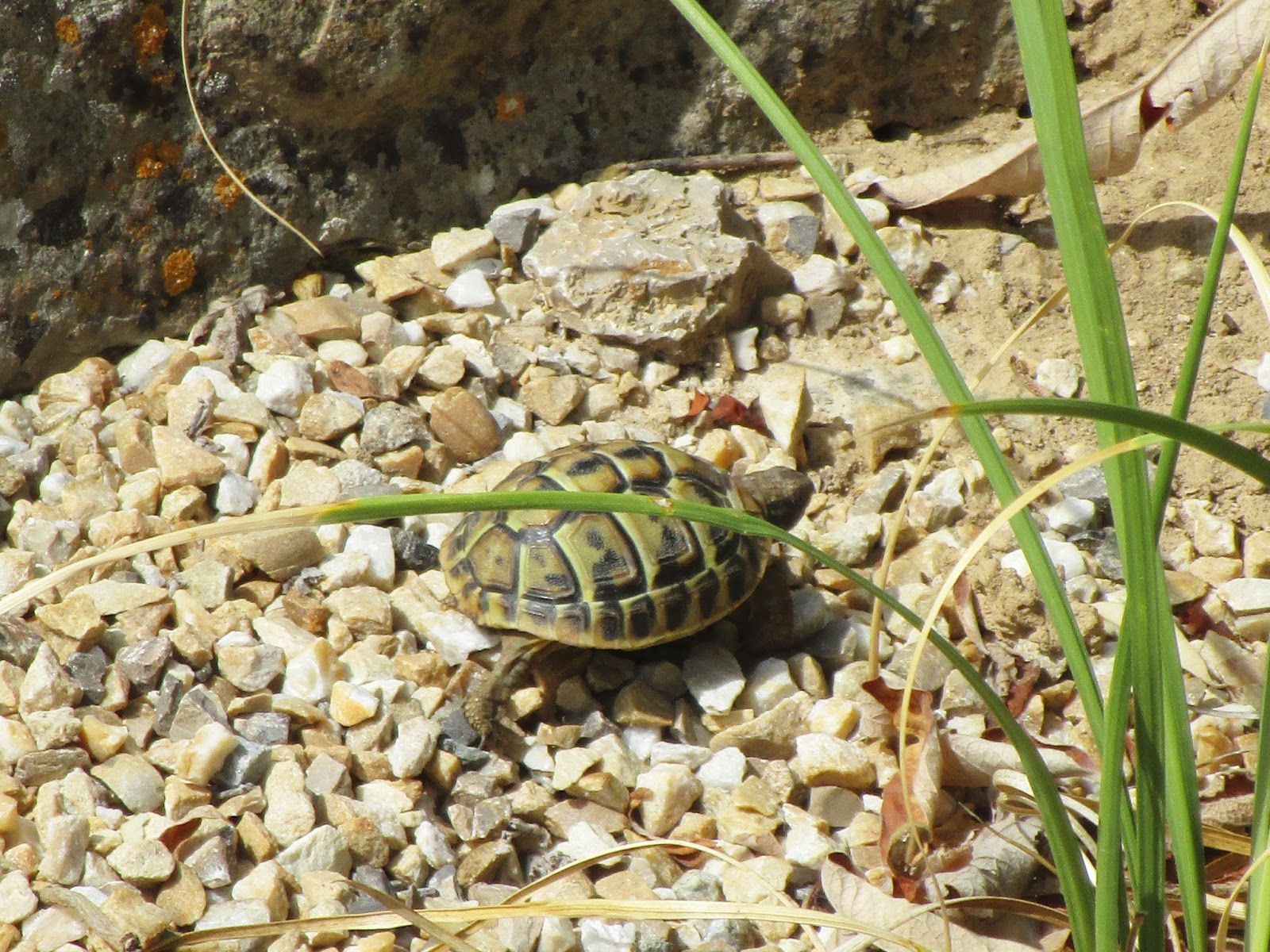

Visitors can stroll around Filippi’s own garden, and we were delighted to meet this baby tortoise.


The garden looks out over the lagoon and the oyster farms.


Although flowers are few and far between at this time of year, the garden was a delight, with many contrasting plants and foliage. Before we left, we bumped into the man himself, who speaks perfect English. He specializes in native Mediterranean plants suited to dry gardens, not needing irrigation, and is in fact a pioneer in this area.  We will be ordering some plants for our garden when we get home in September. He said to plant them in October.


We trudged back to town, briefly taking in the 17th century Chateau Girard, now local government offices. There was also a small covered market, where we made a few necessary purchases, before finally getting down to those oysters:


Tomorrow we plan to make an early getaway before the wind gets strong, and reach the mouth of the Canal du Midi at the western end of the lagoon. Thence, onwards and upwards, perhaps as far as Carcassonne.

Monday, 24 July 2017

Frontignan to Bouzigues – 10 km


Our South African neighbours turned out to be less than welcoming – she monosyllabic, he ignoring us completely. But at least they didn’t chase us away.


Or object to me clambering over their decks this morning to fill up with water, and eventually detach the electricity cable.


We had hoped the wind would go down in the night, and it did a bit, but it was back this morning, so we set off bravely, and rather nervously, past Frontignan's warehouses.


Here we are approaching Sète at the end of the canal.


Boating is big business around here, and they know how to store the speedboats.


Finally we reached the end of the canal and headed out gingerly into the lagoon. The wind was from dead ahead, and waves were building. But we took it slowly and not much spray came aboard, even though we rolled and slammed a bit.


The key navigation mark, or waypoint, is this light on a rock. Not one you would want to programme into your GPS and then set the autopilot!


As we approached Bouzigues, there were oyster farms on both sides. The Étang de Thau apparently produces half the oysters consumed in France – which is a lot. Because it is not tidal, unlike Brittany or the Biscay coast, the oysters are grown rather differently, hanging on ropes suspended from wooden frames.


Bouzigues gives its name to oysters from the whole lagoon, though other villages are active producers too. Here we are approaching the harbour, with some concern because of the wind. We were supposed to moor stern to the quay, and a friendly Swiss gentlemen tried to help us do so, but the wind made it quite impossible, and the harbour-master later agreed that we could remain moored alongside.


After lunch we set off for the oyster museum, which was very informative and not very large. Here is a mock-up of the oysters growing on ropes.


And here, from the video, a chap glueing baby oysters onto the ropes where they will grow to full size.

Tomorrow in principle we would like to move along the lagoon to Mèze, to visit the well-known garden and nursery of Olivier Filippi, who specializes in Mediterranean plants. But if the wind continues – and it is forecast to continue for two or three days – we may just stay tucked up here eating more oysters. Life is hard!


Sunday, 23 July 2017

Aigues Mortes to Frontignan – 55 km


Returning to the gastronomic theme, when we opened the fridge last night seeking the modest lamb kebabs we had planned to barbecue, to our surprise we found these two large steaks and half a dozen sausages. The butcher in Saint Gilles, while friendly, spent most of the time he was serving us talking to the previous customer, a formidable elderly lady who had ordered two large steaks. We saw them being cut. What she said to the butcher when she found our lamb kebabs and marinated chicken drumsticks would have been a pleasure to witness. However, our meal at least was delicious even if hers was ruined.


This morning we set off early to find the Sunday market, passing the main city gates on the way.


The market was extensive and had everything we wanted, including the last of the season's cherries. This year they have been excellent.


We decided to make a little detour, heading through the harbour – you begin to understand how Saint Louis could muster 1,500 ships here – and down the short canal to Le Grau du Roy, the entrance to the Mediterranean.


On the way we passed the Salins du Midi salt works, and observed the mountain of salt awaiting delivery to our tables.


The Grau du Roy harbour was busy, and we turned west along the little travelled Vidourie river, which meets up with the Canal du Rhône a Sète a few kilometres west of Aigues Mortes. There were plenty of fishermen, and jumping fish too. Some of them remarkably large, but elusive for the camera.


There are impressive flood gates where the river joins the canal, reminding us that winter spates can be fierce.


On the canal itself, there was not a lot to see, though at one moment we did spot half a dozen flamingos – white rather than pink, for some reason. Very elegant, but once again they eluded the camera.


A fisherman’s hut broke the monotony before we took a break for lunch at Palavas. This is where we would have turned off to head up to Montpellier. But all our research seemed to indicated that it really isn't a very interesting city, and we decided to give it a miss.


A seagull sitting on the broken-down stone wall that separates the canal from the lagoon was another high spot in the afternoon.

By good luck we arrived in Frontignan 20 minutes before the second of only two raisings of the road bridge across the canal. Lots of other boats were waiting, and we who are heading west should have had priority. But the eastbound crowd roared into action, and happy chaos ensued, though with no apparent ill consequences. We had hoped to find a quayside mooring after the bridge, but no luck, so we have rafted up to a boat about our size with no-one on board at the moment, but flying a red ensign and a South African flag. There is an electricity plug-in post within easy reach. Let's hope the owners will let us remain for the night. The wind has been getting up, and we did not wish to venture out onto the Etang de Thau in a blow. One such experience a few years ago was quite sufficient. It cost us a deck chair and we only just managed to save the barbecue as it was heading overboard.  


Saturday, 22 July 2017

Saint-Gilles to Aigues Mortes – 25 km


These early stretches of the Canal du Rhône a Sète are frankly not very interesting. The abundant vegetation either side blocks out most of the view, which anyway consists mostly of salt marshes.


Being the Camargue, there are, of course, the famous white horses, which we saw from time to time. Some had foals, which, interestingly, are born chestnut, and only turn white as they mature.


Every so often there are moorings, rather bleak and isolated. This barge advertised itself as an artist’s workshop, but we didn’t pause to sample the wares.


As we approached Aigues Mortes, we spotted this straight-backed Camargue cowboy, or gardien, on the bank. No indication of what he was waiting for.


There is a relief canal bypassing the city, but we keep left into the centre. The famous Constance Tower is already in view.


Plenty of boats moored along the canal, some derelict, some less so. 

Aigues Mortes has quite a history. It was from here that Louis IX, Saint Louis, set off for the disastrous 7th crusade with some 1,500 ships – maybe he was on his way to join the troops here when he lunched on that rock on the Rhône. The Constance Tower – the name irresistibly brings a Wodehouse aunt to mind – eventually also served as a prison. Various Templars were tortured and incarcerated here, as well as a famous lady Huguenot, Marie Durand, who was locked up for 38 years, from 1730 to 1768! Today, the town's major activity is sea salt production, and tourists, of course.


Anyway, here we are, nicely tucked up under the tower and ready to set off into town when the heat of the afternoon eases. Tomorrow morning there is a market, and then we will head for Montpellier.


Friday, 21 July 2017

Aramon to Saint-Gilles – 48 km


We made a leisurely start to the day, though a sharp breeze blowing us onto the pontoon made departure a little difficult. Fortunately the Brits moored ahead of us had a sturdy bowthruster and left first. Once they were gone, with more space for manoeuvring, we got away quite easily.


It was only about 10 km to the lock, the first of the day and the last big Rhône lock we will be encountering in this direction. It was all ready, but the lights were against us and we had to wait half an hour or more for this monster (an enormous  "dumb" barge being driven by a pusher) to arrive and take its place up front. Then we and the Brits, who had also been forced to wait, slid in behind.


Talking of monsters, this is the castle at Tarascon, which is subject of a juicy legend passed down from generation to generation to generation. A bit like Facebook or Twitter, so the result may well be fake news – who can tell?

Anyway, it seems that a monster called Tarasque lived in the river around here about two thousand years ago, coming out into the town at night to eat children. It also killed people trying to cross the river.  Fortunately Saint Martha (not yet a saint, I suppose, but soon to become one) turned up and calmed down the monster by winding a scarf round its neck. She then led it into town, all quiet and docile, whereupon the population promptly massacred it. It just goes to show: if you are a monster, don’t trust saints.


The castle was actually built between the 12th and 15th centuries by various kings, including René. When its use as a castle was over, it became a prison – the fate of many castles, I imagine. It has a rather gruesome reputation thanks to two massacres of prisoners, in 1795 after the Revolution, and more recently in 1926. Today it is a museum.


There is nowhere for small boats to moor at Tarascon, so we sailed on, finally reaching the point where the Petit Rhône breaks away from the main stream, winding its way through the Camargue down to Les Saintes Maries de la Mer.


We would have liked to go down all the way to the sea, but the channel is only dredged and marked for  the first 22 km, after which it is definitely not recommended, particularly with the water as low as this. So we went through the Saint-Gilles lock, and are now moored in the village. Our shopping expedition was particular successful, including what seems to have been an excellent butcher. We shall discover tonight.

Tomorrow we head west along the Canal du Rhone a Sète, in the direction of Aigues Mortes.

Thursday, 20 July 2017

Avignon to Aramon – 11 km


Our rest day in Avignon turned out well. We managed to contact a mechanic, on the recommendation of the very pleasant and efficient lady port captain. He came within an hour or so and had a look at the engine. He had a pressure device which quickly located the leak, in a rubber hose. He removed it and promised to be back today in the afternoon to replace it. Cost estimate – well, think of what the call-out plumber costs at home and double it. That’s boats for you.

That sorted, we set off to explore the city a bit – deciding to avoid the papal palace which we have seen before, considering those four hotel boats moored up downstream. We found Avignon celebrating its annual theatre festival, which works a bit like the Edinburgh Festival: lots of little amateur companies offering their performances in a myriad of venues. Almost every vertical space was plastered with show posters.


First of all, it was a matter of lunch, in the Carmes squares, which is very central. Special budget platters for the festival were everywhere on offer. This one turned out to be not bad.


Meanwhile several groups of performers passed through the square giving us tasty samples of their shows. However, we pressed on to a rather good small museum in a former private house: interesting pictures and furniture. The afternoon was turning hot and muggy, so we retreated to the boat, after a little necessary shopping, and chilled (!) out.


This morning we sorted out our business with a bus ride out of the centre. The city walls, almost unbroken around the old city, are very fine.


So too is the University. Dating originally from the 14th century, it was closed in 1792 after the Revolution, only reopening in 1984. It now has some 7,000 students, about 15% foreign.


A stroll through the centre of town brought us back to Carmes square, and a bar serving nicely chilled beer.


Our mechanic finally turned up and installed the new hose, so we could get away. First stop was the fuel dock, which boasts an extraordinary collection of weeds growing out of the wall. We took on some 115 litres of diesel. That’s what we have used on the 443 km trip down from Saint Jean de Losne. About 3.85 km per litre, which is not bad for a boat of this size (11 metres).


Leaving the city and rejoining the main river - quite wide at this stage - we passed under the TGV (high-speed train) bridge. We have often crossed it in either direction on trips to and from Paris.


Looking back, we caught a final glimpse of the city, for the moment at least. Now we are tucked up in a new harbour on the banks of the river at Aramon. Tomorrow we should get onto the Canal de Rhône à Sète.