Sunday, 13 August 2017

Avignon


We made it to the flea market quite early. In fact, some of the stallholders were still setting out their wares. But there were only about a dozen, and it was mostly old clothes, shoes and portable phones. However, Diana did pick up a Ralph Lauren powder-blue polo shirt for 1 euro, so that was a success.


We walked along Carnot street and admired this Art Nouveau fountain, though it was not playing.


The real centre of Avignon is the Place de l’Horloge, or Clock Square. Here you find the impressive town hall, and also the Opera. The clock itself is difficult to spot, hidden away on a tower behind the façade of the town hall. But we found it. We hoped the figures up there would get moving when the clock struck, as they often do in Holland, but no such luck.


Close by is the Papal Palace and the Cathedral. Very impressive, and much visited. We have done the tour before, and decided to skip it this time.


But we did decide to go to the art museum, the Petit Palais, at the top end of the square.


It is an impressive building in its own right, for example with this chapel ceiling. The permanent exhibition is mostly Italian religious art from the 14th, 15th and 16th centuries.


The high point of the tour – and there were very few other people looking around – is a Botticelli room, with this wonderful Madonna and Child.


On a slightly lighter note, we liked this painting, entitled Madonna to the Rescue. The Madonna, a super heroine of  yore, is about to whack the devil who was clearly tempting the young.


Once out and with time to kill, one member of the party opted for a quiet beer in the shade, while the other headed for the broken bridge. But finding that you have to pay to walk on it, she returned to have a beer too. This jazz-playing busker helped assuage the disappointment.


Then it was time for lunch at the restaurant of the Pope’s mustard maker – La Moutardière du Pape. The dish of the day was a pork chop with mustard cream sauce,  accompanied by carrot puree and a mushroom souffle. And very good it was too.

After lunch, to burn off a few calories, we climbed to the top of the papal gardens overlooking the river and the city. The views certainly repaid the effort. Unfortunately the battery of the camera had given up by this stage and although we took some shots with the phone, we have not discovered how to upload them to the blog. 

Back on the boat we found that the electricity supply here won’t support our washing machine, which is a bore. But on the credit side, our friends Norman and Pat arrived from Beaucaire, and rafted up alongside us, in the absence of other space.

The forecast for tomorrow is promising, so we will probably head off north.

Saturday, 12 August 2017

Aramon to Avignon – 14 km

When we got up, there was not a breath of wind, flat calm on the river, clear sky – an idyllic day in prospect. Well, until 9 a.m., that is. On the dot, the wind sprang up, howling down from the north. Mistral. But with only 14 km to cover, we set off undeterred, soon passing under the twin TGV bridges.


It was slow going, all the same. With wind and current against us, we were not making much speed. There was a giant container barge coming up as we set off, and soon we passed a double fuel barge going downstream. But otherwise there was little traffic on the river.


As we pushed into the Avignon branch of the river, with the current much stronger than when we left (has it been raining in the Alps?), we felt the big wheel added a certain Disney feel that was not wholly inappropriate.


All the same, the palace does look impressive.


And the broken bridge is always an attraction.


Our online research revealed that we could still get to the Halles covered market in time for some shopping, so off we set. Our route took us past the St Jean tower, with a square full of cafes and restaurants in front.


The market itself has an unusual facade, a wall of vegetation.


Inside, masses of enticing stalls. As Diana commented, you really shouldn’t go shopping when you’re hungry. We bought far too much, and definitely patronized potato heaven. Atkins go hang!


After shopping, we went in search of a flea market that we had read about. But it was nowhere to be found. We did see this attractive church, though, possibly St Pierre d’Avignon. When we got back to the boat and consulted the internet again, we found that the flea market is tomorrow morning, not today. The wind shows no sign of abating until Monday, so it looks as if we will be here tomorrow. If so, we will check it out.


Friday, 11 August 2017

Beaucaire to Aramon – 80 km


How to spend 8 1/2 hours cruising over 70 km, through three locks, and end up 1 km from where you started? Well, it is all down to that lock in Beaucaire that was closed when the river level changed. So we had to retrace our journey down the Canal di Rhône à Sète, turn off through the Saint-Gilles lock to the Petit Rhône. Chug upstream on that for 25 km, move into the big Rhône, and finally get to Tarascon, which is just across the river from Beaucaire, where we started hours earlier.


We knew it would be a long day, and with a mistral threatening at the weekend, we decided to get as close to Avignon as possible. No signs of early morning activity on Rickwayne as we crept past. But they aren’t leaving till Sunday.


There’s just the one lock to negotiate on the way down, so we had time to conclude that this canal is not the most exciting one that we have travelled. It gets you from one place to another, but is just not very interesting. Perhaps really it was a mistake to have gone up to Beaucaire, even though we did have the pleasure of meeting Pat and Norman again. But the place itself, having been bypassed, seems a bit run down and rickety.


Anyway, soon we were on the little Rhône, and pleased to find the current quite gentle.


It was a different story when we emerged on the big Rhône: I had forgotten that south of the Beaucaire dam and lock the current can be very fierce. And indeed it was. At times our progress was reduced to 5 kph, though 6 or 7 was more usual.


This slow progress gave us plenty of time to admire these elegant wind turbines, revolving merrily in the stiff northerly breeze, and reflect on how many more will be needed to charge up all those electric cars that we will be using when petrol and diesel engines are banned in France and the UK (2040 is it?).


As we came slowly abreast of Beaucaire, and Tarascon across the river, we were finally able to photograph the castle, which we failed to do when staying there yesterday. Quite a fine pile.

Once we had been raised the 15.5 metres up the Beaucaire lock – rapid and painless – we found the current much reduced and were able to progress at our normal cruising speed of about 9 kph. One excitement was seeing a Canadair firefighting plane dip down to scoop up water from the river. Unfortunately he was too far from us, and up-sun, so photos were not possible.


Eventually, after about 10 hours on the go – we took turns at the wheel to have lunch on the run – we found a berth here at the new river port of Aramon, rafted up to a barge. Tomorrow we will do the short leg into Avignon, and have a bit of a rest.


Thursday, 10 August 2017

Aigues Mortes to Beaucaire – 50 km

We slid out from the plastic embrace of our overblown hire-boat neighbours quite early after topping up the water tank. The day was fresh and even felt a little autumnal, and there were no other boats on the canal for quite a while.


The first excitement of the day was meeting a dredging barge, right in the middle of the canal. There was not much space to get by, but they waved us through and there was no problem. I think this is the first dredger we have seen in France. In Holland there were many.


We saw quite a few camargue horses, some white and some not so white. All very decorative. At one point, someone had dumped loads of apples on the canal bank for them to enjoy. Subsidized overproduction thanks to the CAP – common agricultural policy – I suppose. It’s a shame to see good food wasted - though the horses don't think so!.


The canal runs almost dead straight for the 50 km to Beaucaire, which used to be the junction with the Rhone. But engineering works on the Rhone changed the level of the river and left Beaucaire isolated and its lock unusable, although it is still a popular harbour for pleasure boats. The single lock of the day raised us four metres, which I suppose is Beaucaire’s altitude above the Rhone these days.


As we slid into Beaucaire looking for a mooring, we spotted the handsome Linssen 40 belonging to our friends Norman and Pat. We met them on the Seine last year and we had planned to travel through the Burgundy Canal together until they realized that their boat would probably not fit into the tunnel at the summit. We  were delighted to meet up with them again today and enjoy a glass of wine together. 

They plan to set off back up the Rhone on Sunday, we tomorrow, but much slower. So we may meet up again along the way.

Wednesday, 9 August 2017

Lattes to Aigues Mortes – 30 km

After posting our daily blog yesterday we were invited to have a glass of wine with some friendly New Zealanders on an adjacent hire boat. They had experienced an even more torrid time than us at Frontignan, the other side of the bridge – boats rafted up three abreast, no facilities, desperate families.

So this morning I walked round the harbour to the office of the leading French waterways magazine, Fluvial, which just so happens to be based in Port Ariane and to which I subscribe. The charming editor gave me a good cup of coffee, and we discussed magazine editing for a while (from what I could remember of Yachting World). Then I raised the Frontignan problem, and suggested that the magazine should try to have something done about it. After all, if in the Netherlands bridges can be raised on demand, why in France are they limited to twice a day, with the resulting stress and aggravation for holidaymakers, on whom their economy relies? She seemed sympathetic.

It was a pleasant encounter, after which we set off back down the Lez, finding the remote-controlled lock open and waiting for us.


Down on the canal, there was plenty of traffic, but the main excitement was seeing a bunch of flamingos feeding in the lagoon alongside the canal. Not easy to photograph, but this gives an idea.


We had to stop, turn round and motor back to get the pix, and evidently others realized we had seen something interesting.


This canal is quite dull at this stage, so it was pleasantly distracting to see a group of paddle boarders.


Also surprising to encounter a laden commercial barge, which beckoned us to overtake. Not many around at this time of year.


There were a few Camargue horses to be seen too, this one hiding behind a fence post.


Then we were nearing Aigues Mortes, guided in by Lady Constance’s tower, under which we are moored up among a dozen or more hire boats. The port staff tried to persuade us we would be happier along with other private boats, much further along the quay from the town. But we resisted their suggestion that we should move.


After lunch we set off into the walled town, observing other sorts of boat trips. Inside the walls, the town was as crowded as Carcassonne.


We checked out the tourist office for possible Camargue exploration, but nothing appealed. Then we went to a couple of art galleries, one where we saw a painting years ago that we always regretted not buying. Not surprisingly, it is no longer there! So there was nothing for it but a beer and a sangria in the busy main square.


The main city gate is as impressive from the inside as out.

.
Did I mention we paused to stock up on essential supplies – Camargue Vin de Sable this time.


Tuesday, 8 August 2017

Frontignan to Lattes–24 km approx

It was a grey, windy morning, with a strong breeze building from the north-west. A good thing we crossed the lagoon yesterday. We decided it would be best to get away before the morning bridge lift, preferring to travel alone, not in a big convoy.


A few hardy fishermen were out on the canal banks, and we met a one or two boats coming the other way.


On an otherwise quite monotonous passage, the swing footbridge at Le Maguelonne is always fun to watch. The bridge is hinged at the north-shore end, and swings in and out on floats with a normal boat engine and propeller. The operator saw us coming and there was no delay.


At Palavas we turned north onto the river Lez – new territory. At first it was lined with the usual abandoned, semi-abandoned and sunken boats, but soon it turned rural and was rather pleasant. There was one, remotely controlled lock to negotiate.


Then we turned into the magnificent Port Ariane (at 35 euro a night it ought to be magnificent!). It is a major development with apartments, restaurants, shops and offices all around, and good solid moorings in the middle. One hire boat company has its base here.


Lattes is as far as you can navigate up the Lez. It is a modern town a few kilometres south of Montpellier itself, with a good regular tramway link, which we duly sampled.

Our first stop in Montpellier was the Tour de la Babote, originally part of the city's 14th century fortifications It was subsequently used as an astronomical observatory in the 18th century, and later on as a telegraph tower.


We then embarked on a pretty intensive walking tour, starting at the church of St. Roch.


The narrow, winding streets of the older part of the city were quite charming.


At the top of the hill we caught our breath and admired the local Arc de Triomphe, built in the 17th century to honour Louis XIV.


The Palais de Justice is a neoclassical 19th century addition. I think we recognize the style.


Finally we reached the 14th century Cathedral, with its unusual twin-pillared portico. However, unfortunately it was closed for building work and we couldn’t explore inside. Quite a disappointment.


As was a similar closure of the adjacent School of Medicine. Montpellier has one of the oldest universities in the world, and the School of Medicine is reckoned to be one of the oldest operating medical schools in the western world.

Our conclusion, then, is that Montpellier has been well worth the detour, and we are glad we were not deterred by negative, Trip Advisor-type comments. Tomorrow it looks like we'll be going back to Aigues Mortes, where we'll try to arrange more Camargue exploration.


Monday, 7 August 2017

Marseillan to Frontignan – 24 km


Enough of all this boating. Let’s get in a bus and go to the beach! So we did. The bus ride took only 25 minutes, and as you can see, other people had the same idea.


It got busier by the minute as people poured out of the adjacent campsites. All the same, the water was refreshing, and seemed reasonably clean, and we enjoyed our swim. The sands stretch for about four km, with a post-war little holiday town and lots of campsites behind.


Although we had a beer while waiting for the bus back to Marseillan, we were not tempted to linger long.


This was one view from the bus through the window.


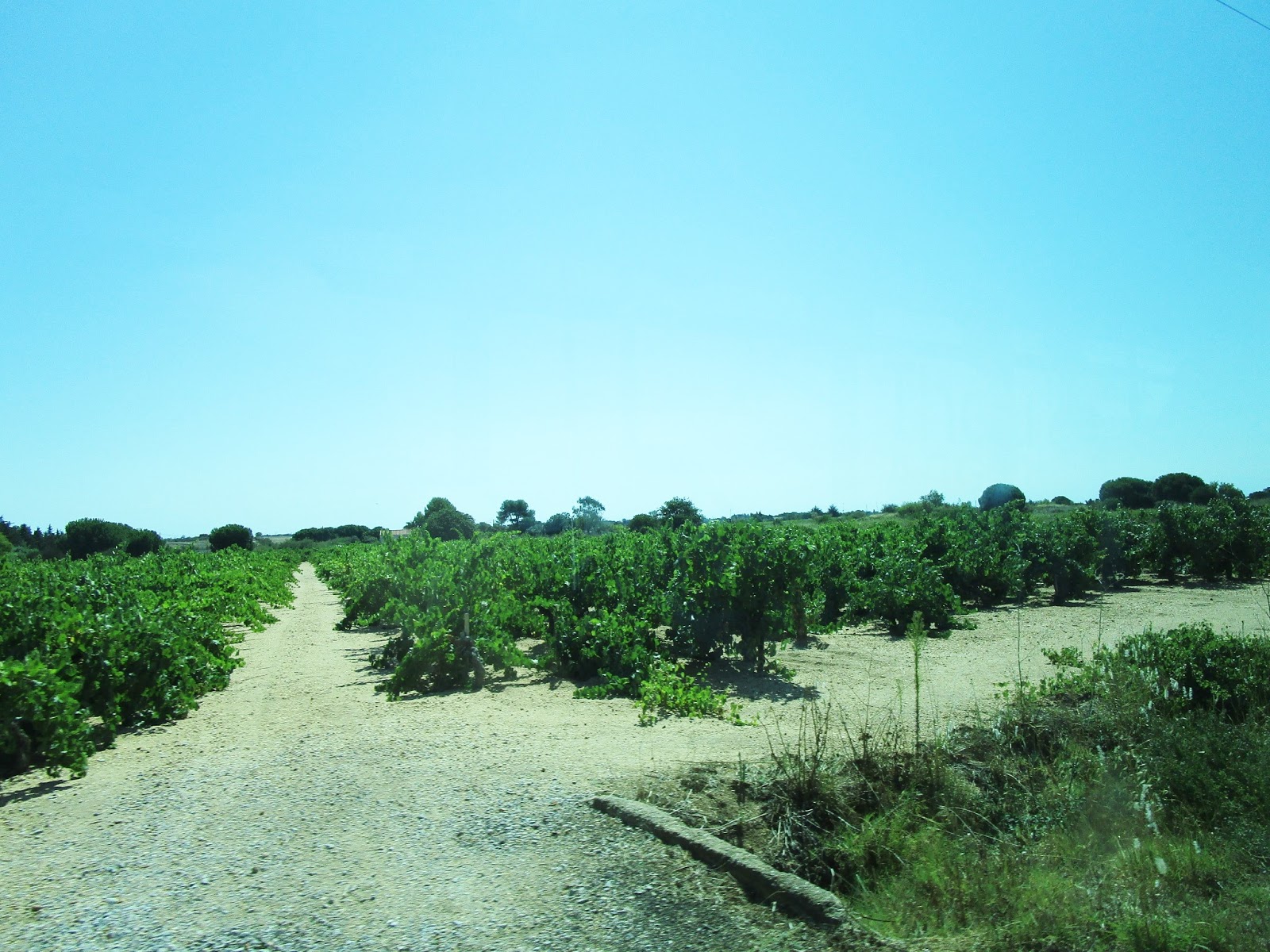
The many vineyards in the area are more inspiring.


In fact they inspired us to have another good lunch before leaving this oyster paradise. This is the after, not the before, by the way.


Then with the wind quite light from the south, we headed out into the lagoon for the 18 km open-water voyage to the mouth of Canal du Rhône à Sète. We treat the Étang de Thau with considerable respect after our previous experiences, but today was delightful, a few waves to rock us, but nothing nasty. Even the wash of passing speedboats was not a problem.


Navigation can be a bit of a challenge because the shoreline looks much the same and there are few distinctive landmarks. Or it would be without our GPS navigation system, which showed us the way very accurately. Even so, it was a relief to pass the light on a rock.

We reached Frontignan half an hour before the afternoon bridge opening. More than a dozen boats were waiting on our side, and more on the other. So it was a bit of a mad rush when they finally lifted the bridge. We decided to moor up just the other side, and tomorrow we will after all venture up to Montpellier. Further research has persuaded us that it might be worth a visit. We will see.